
Blogs
Dance Knowledge | Blog by Loes van Deursen
On September 25th 2025, Dramaturgy for Devices organized a workshop on dance knowledge. The participants included choreographers, roboticists, dramaturges, and performance scholars, each of whom brought their own distinct understanding of and relation to dance. Four choreographers/researchers were invited to share their view of what dance knowledge entails. The aim of the workshop was to exchange perspectives and explore how notions of dance knowledge support ongoing research within the Dramaturgy for Devices group. This blog post reflects on this workshop.
The workshop began with an invitation to listen to the choreographers/researchers with two questions in mind: What resonates with your own research, and how might the presentations open new directions?
Anouk van Dijk – Countertechnique
The first speaker was Anouk van Dijk, a dancer and choreographer, and the founder of Countertechnique. Van Dijk approached dance knowledge as something that must be generated in and through movement. Countertechnique treats the dancing body as a dynamic, self-organising system, equipping dancers with a corporeal “toolbox” and an ongoing awareness of their internal state to translate information directly into action. Building on this understanding, van Dijk described dance knowledge as emerging through three distinct categories: how bodies move, how systems are organised, and how meaning is created through perception. These categories are associated with different but interconnected actors: the dancer, choreographer, and spectator. The dancer develops embodied knowledge by sensing, adapting, and moving in relation to their own body and surroundings. The choreographer works at a distance from this immediate experience, organising bodies in space and shaping movement patterns and rules. The spectator engages with the work from the outside, creating meaning through perception and responding affectively to what unfolds in performance. In van Dijk’s presentation, these perspectives were explored in relation to robotics, raising the question of what the potential might be of applying Countertechnique within robotic systems. This question is currently being taken up in collaboration with van Dijk and roboticists, with further exploration planned, and points toward a broader avenue for future research.
Ruth Gibson – Skinner Release Technique
The second speaker was Ruth Gibson, a visual artist, choreographer and Associate Professor at the Centre for Dance Research at Coventry University, UK. She opened with a quiet demonstration: slowly, Gibson lowered a scarf to the floor. As more of the fabric touched the ground, it gathered into a growing pile, seeming to gain weight as it accumulated. When she carefully lifted the scarf again, the heaviness dissolved. The fabric felt light again, and swirled upward in a soft, spiralling motion. This demonstration served as an embodied metaphor for what she had us do next: gradually releasing the tension that maintained our bodily form and allowing ourselves to sink naturally into our chairs. With this brief exercise, she demonstrated a fundamental aspect of Skinner Release Technique (SRT), a practice centered around the idea that releasing physical tension enables more freedom, power, and articulation in our movements. Through guided imagery, sound, and spontaneous motion, the technique encourages a deeply embodied awareness, making new ways of movement possible, both in the dance studio and in everyday life. Gibson highlighted this potential by drawing upon an example from her own practice: two groups of dancers, in separate locations but dancing together in virtual reality, were intuitively able to embrace one another’s virtual avatars through movement alone. To Gibson, this communicated the power not so much of dance knowledge as of movement knowledge more generally: the role that our motions play in our self-positioning within the world.
Suzan Tunca – Intuitive Body
The third speaker was Suzan Tunca. She is a dancer, choreographer, and head of dance research at ICKamsterdam. Tunca approached dance knowledge as something rooted in the intuitive body. This approach, developed by Emio Greco, Pieter C. Scholten, and their company, focuses on how conditions for movement arise before movement actually occurs. To illustrate this, she described Double Skin/Double Mind, a method for discovering the body’s sensitivity to make it available to the creative process of dance. The method uses the basic principles of breathing, jumping, expanding, and reducing. Tunca also spoke about her long-term work on dance documentation, where she developed vocabularies and tools for archiving and analyzing dance practices.
Kim Vincs – Motion Capture
The final presentation was given by Kim Vincs, a choreographer, interactive media artist, and Senior Principal Research Fellow in art/technology at Swinburne University of Technology in Melbourne. Vincs discussed her research on motion capture, noting how conventional VR technologies rely on rigid templates that assume certain body shapes and abilities. Such systems often fail to account for soft tissue or fluid, continuous movement, which are both central to dance. Drawing on dance principles, she argued for understanding the body as a dynamic, flowing mass rather than a set of fixed limb positions. As part of this, Vincs argued that dance knowledge is not a conceptual body of ideas to be garnered and applied, but rather a more embodied awareness of oneself that is set in motion through dance.
“Magic of the Movement”
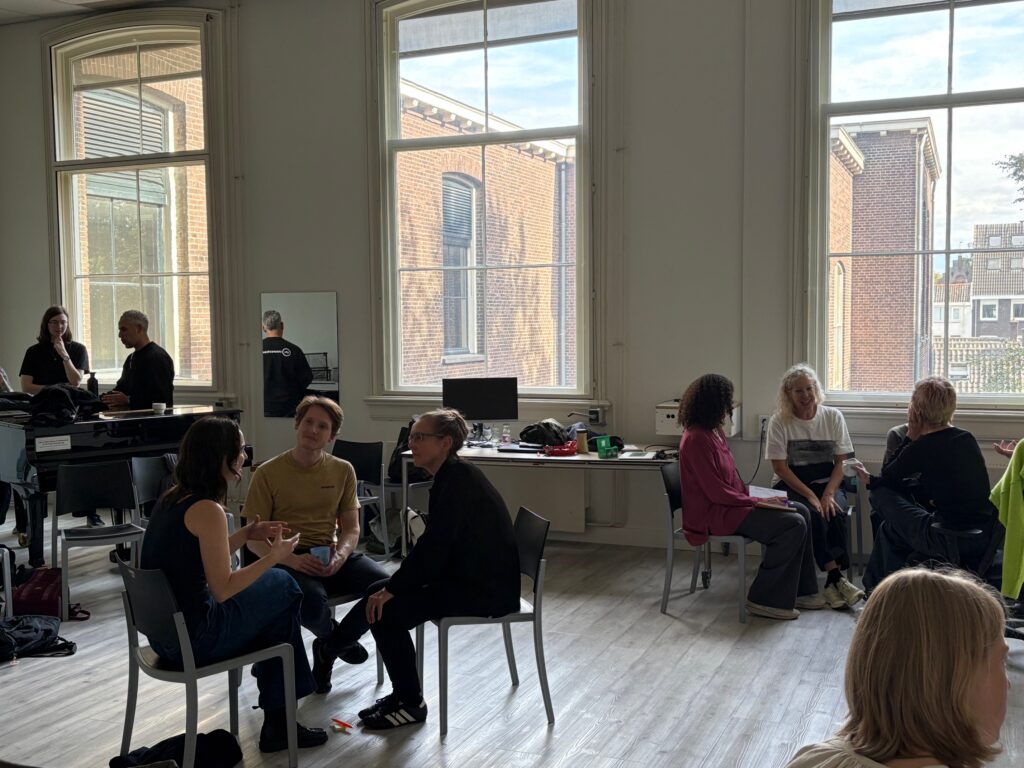
After the presentations, we broke into small groups to reflect on the two central questions of the workshop, what resonated with our own research, and how these new perspectives might open up new directions. In the general discussion afterwards, intuition emerged as a recurring theme. Intuition here was discussed as understanding dance knowledge as something that arises from the subtle interplay of body and mind. This raised a compelling question about working with movement and robotics: can intuition, or the “magic of movement,” be translated into code? And if so, do we even want that? Rather than trying to make robots imitate humans, several people asked whether expressive movement might emerge from interacting with technology on its own terms, as in the concept of ‘ensoulment’ advocated for by Maaike Bleeker and Ulrike Quade, who were both in attendance.
Further points of discussion arose from the roboticists amongst us, namely regarding the purpose that different dance methodologies played. What, they wondered, constituted these methodologies? Where did differences arise? What was foregrounded and, conversely, neglected? And what import did this have on HRI? Should they search for a dance methodology that was ‘best suited’ to robotics, or attempt to incorporate lessons from each into their practices? Although we didn’t come to a conclusive answer to this question, it remains a pertinent consideration for research going forward.
In short, the workshop facilitated a first introduction to dance knowledge. Although there were certainly still barriers–roboticists felt they did not have the correct vocabulary to understand or programme different movements, while performers did not necessarily understand the possibilities of programming–the recognition of such concerns is the first step towards addressing them, something that the entire team will hope to do as the project develops in the future.