
Blogs
Mutual Puppettering: Developing Robot Opera at Theater Sonnevanck | Blog by Bianca Gotti
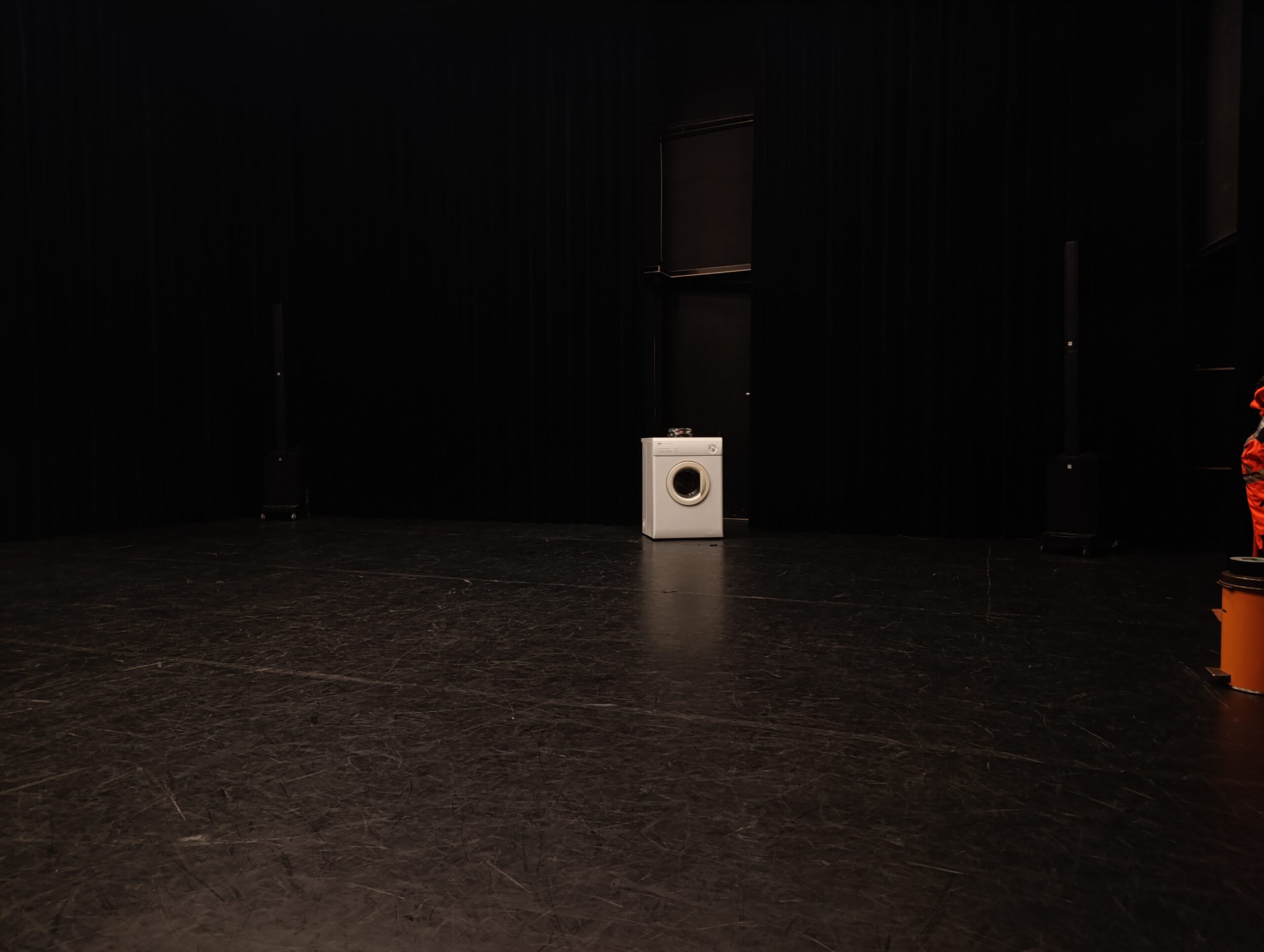
On December 9th, 2025, the kick-off of Daniël van Klaveren’s work-in-progress Robot Opera (provisional title) took place at Theater Sonnevanck in Enschede. Drawing scenographic inspiration from Simon Stålenhag’s graphic novel The Electric State, the play is set in a junkyard inhabited by abandoned household objects. Among the devices scattered on stage—including a vacuum cleaner and a couple of bins—there were two prototypes that would have become the main protagonists for the rest of the day: a lamp and a washing machine. Both devices were casted in the thrift store and transformed into robots by professor, maker, and engineer Edwin Dertien. With the use of a handheld controller and a microphone, two actors were able to puppeteer these everyday appliances, giving them the possibility to move and make sounds.Remotely puppeteered, these everyday appliances quickly revealed their different personalities.
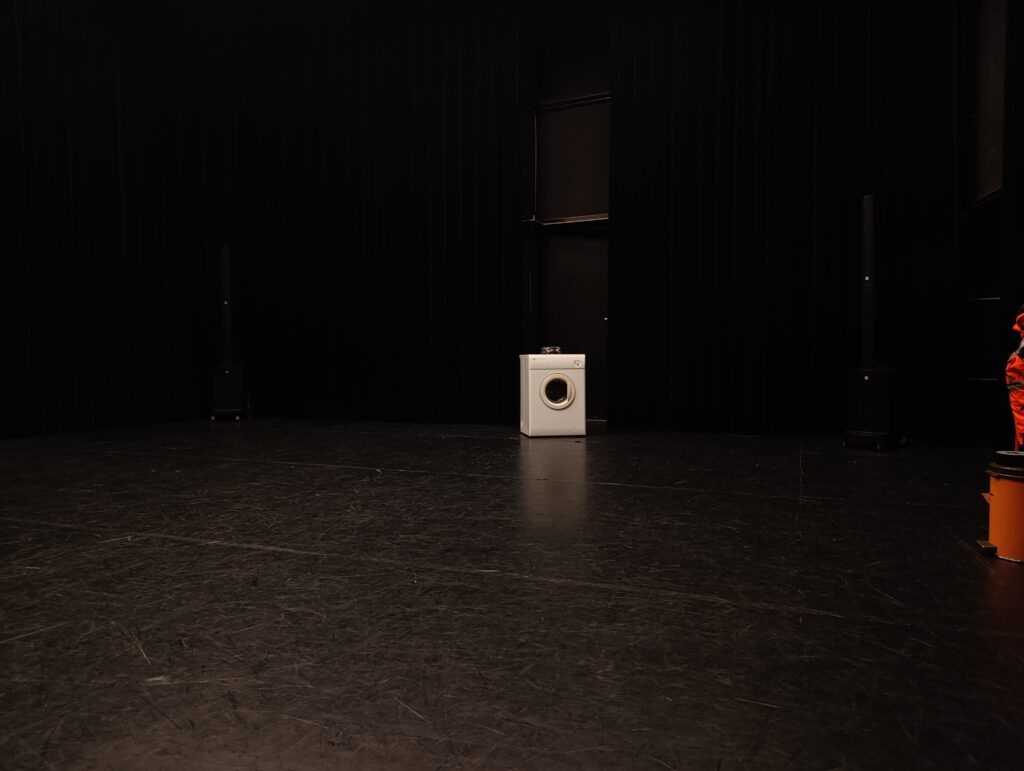
The washing machine was mounted on wheels that enabled it to move across the stage. Its cube-shaped heavy body gave it a sturdy yet clumsy presence, giving the impression that it could bump into other objects at any moment. Its porthole functioned as a mouth, opening to emit breaths, vocalizations, and coughs that one could have imagined accompanied by puffs of smoke. Meanwhile, its program selection knob—resembling something between an eyebrow and an antenna—rotated, communicating shifts between emotional states or scanning and navigating its environment. The lamp reminded of the iconic Pixar mascot; although it remained fixed in place rather than hopping here and there on stage, it was no less expressive. Its bulb moved in every direction, giving the impression of a living being that moved its gaze with intention, scanning its surroundings and reacting to others inhabiting it. Its thin, jointed, and sinuous body made it look both elegant and nervous as it quickly extended and withdrew, curious and easily frightenable. The lamp had three light color options, and as it switched between these colors, its movements acquired different meaning, amplifying different emotional tones. When the eye turned red, it seemed angry and aggressive, while when it turned blue, it took on a watery appearance, as if it was about to cry.
The characters of the devices emerged both through their object-specific affordances and the exploration and improvisation of the puppeteers with them. Some of the devices’ qualities were not designed but emerged from their technical structure and components such as their shape and joints. For example, their motion range helped create contrasting personalities. The washing machine’s movements were limited in expressiveness but spatially unconstrained, while they were more contained but nuanced for the lamp. Their speed and pattern—slow and jerkily for the washing machine , fast and undulating for the lamp—amplified the sensation that the lamp was somehow more of an introvert and shy than the rumbling washing machine. Sound especially, was an element that seemed to highly contribute to the devices’ liveness. The washing machine moved silently but could start drumming at any moment, loudly opening and closing its mouth. Nevertheless, the most interesting noise came from its program selection knob and the mechanism making it rotate. The lamp too was accompanied in every movement by similar noises, whirring with the rotating of its joints.
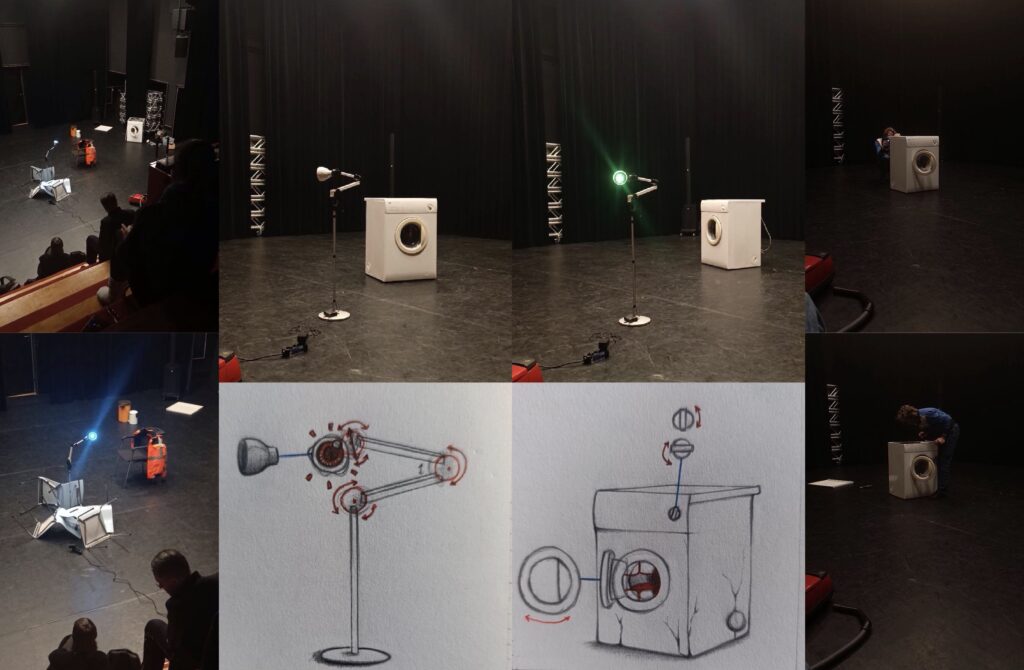
It became clear that, most of the time, aesthetic decisions followed practical solutions, leveraging technical limitations and exploring creative possibilities within constraints. For instance, the lamp became quite shaky when it moved slowly, while it was more stable when moving fast. Instead of thinking how to ‘fix’ the issue, it became a characteristic of the device. In this way, limitations of the devices became features that contributed to create their characters. It was also interesting to notice how the process was affecting the singers/puppeteers Jennifer van der Hart and Mike Zanting. While they were remotely controlling and adding their voices to animate the robots on stage, the devices seemed to take control of the singers’ movements. As Mike was puppeteering the washing machine, his body stayed still, while the muscles of his face moved as most of the device expressions were coming from the mouth. As Jennifer was puppeteering the lamp, her body stretched and hunched over, swaying from side to side while embodying the device’s expressive movements.
The actors were following the devices, tuning in to their movement and expressive possibilities. As Soyun Jang suggests, attunement is deeply embodied and material and can help both finding movement for a more-than-human body and at the same time making sense of it (2024, 72). By allowing the material specificities of the devices to lead their performance, the actors engaged in a sort of mutual puppeteering where agency and control were shared. In this co-performance, the boundaries between object and subject blurred: the remotely controlled devices not simply prothesis or extension of the performers and the latter not fully in control but themselves puppeteered by the devices.
References
Jang, Soyun. 2024. “To Attune to a Robot Arm: A Moving Body’s Perspective of Speculating, Programming, and Dancing with the Robot.” Master Thesis, Utrecht University. https://studenttheses.uu.nl/handle/20.500.12932/46703