
Blogs
A Dance Perspective on Moving Robots | Blog by Vasiliki Sivena
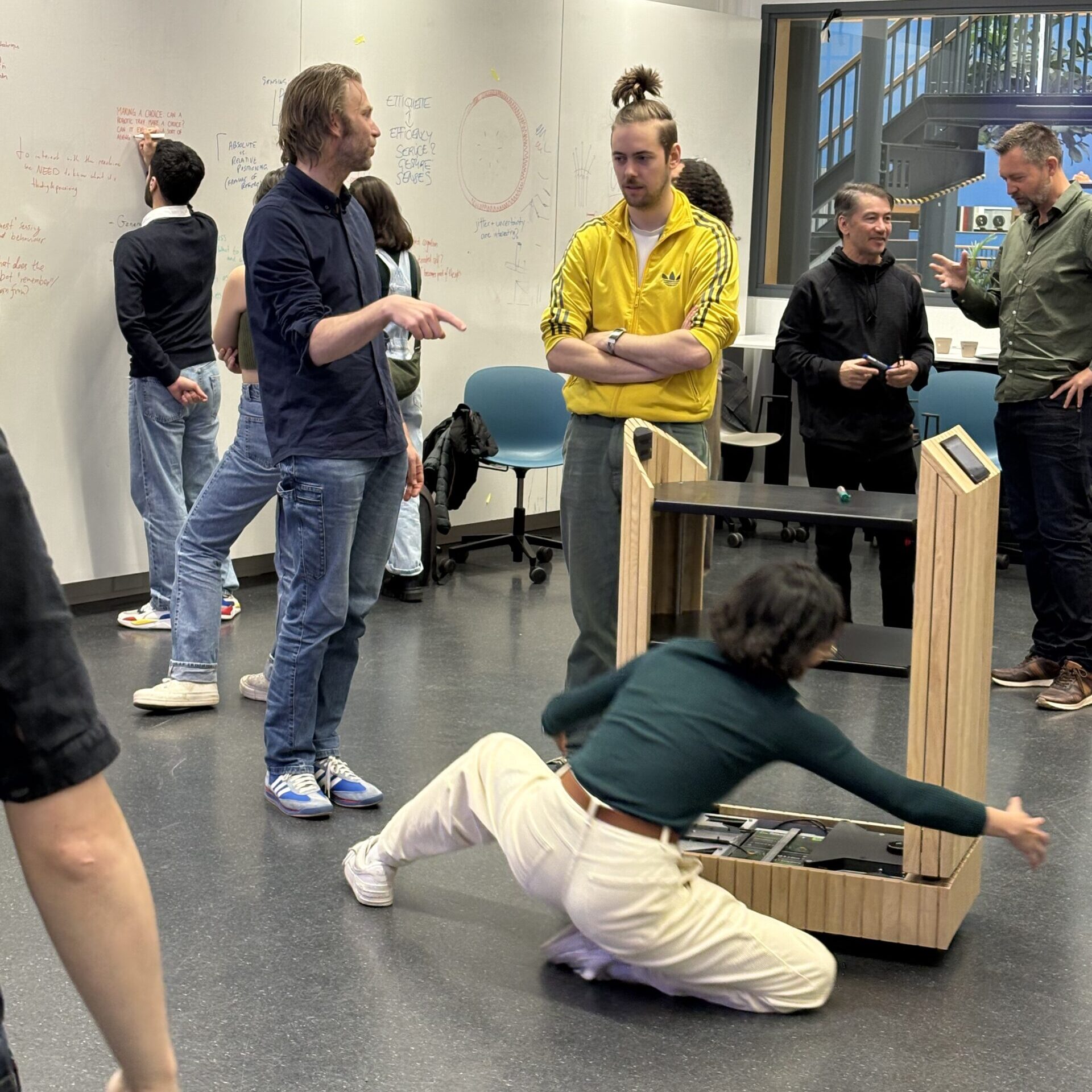
On Monday 11 May 2026, Dramaturgy for Devices (D4D) organised a workshop in Delft at the Faculty of Industrial Design Engineering (IDE), called “Countertechnique for Engineers.” The workshop served as an introduction to Countertechnique, aiming to discover inspiration and practical methodologies for integrating the technique into human-robot interaction (HRI).
This seminar emerged from the Dance Knowledge workshop (25th September 2025), where they tried to explore how to make concrete connections between dance knowledge and robots; how to build bridges between these two fields. “Dance knowledge is not what initially people tend to think”, Maaike Bleeker said. “It is more than movements and creating choreographies. It is about relationships between performers, their interactions and about bodies moving into space”.
Anouk van Dijk developed Countertechnique from her own dance practice and movement research, focusing on the intimacy between bodies. She explores “extremes” through movement, and she concentrates on how to experience work in performing arts. These keywords, “intimacy”, “extremes”, “experience”, inspired her to create this method, a system designed to help dancers cope with the physical and mental demands of prolonged rehearsals and repetitive movement. Its principles can be applied across a wide range of dance forms, including ballet, ballroom dancing, hip-hop, and other movement practices, remaining an evolving methodology that continues to develop over time.
Expanding her research, she examines the relationship between Humans & Systems, where “systems” refer to ecological, political, cultural, and other interconnected structures that deeply impact performers and must be considered by movement scholars. Within these frameworks, she explores the human experience through five core inquiries:
- How do people coexist? She studies interpersonal and relational connections, examining how performers organize themselves and act collectively.
- How can people be vulnerable? She investigates ways of fostering respect, trust, and openness when dancers and performers work together.
- How can people be equals? She explores concepts of bodily strength and examines how masculine and feminine qualities are expressed and perceived in movement.
- How can people surrender? She questions whether the environments and systems in which we live and work allow individuals to let go, trust, and yield control.
- How can vitality be preserved? She reflects on the concept of vitality through the inclusion of performers of different ages. For example, she has studied how a dancer in their twenties moves through space compared to someone in their fifties, drawing on examples from her own choreographic work.
Turning to the concept of systems, central to her approach is the question, “What if?” This question drives her exploration of systems governed by both chance and choice, allowing her to investigate how different structures, decisions, and possibilities shape movement, performance, and human interaction.
As a modular “system of propositions,” Countertechnique functions as a toolbox from which practitioners can dynamically select and combine tools rather than following fixed, prescriptive rules. It treats movement not as an isolated action, but as the collective output of multiple overlapping systems ranging from physical components like muscles, joints, and organs, to internal and external inputs such as nutrition, sleep, and psychological state. Within this framework, all these variables are processed as information that shapes both body and mind. Ultimately, the method empowers performers to consciously choose which elements to focus on, allowing them to adapt the system to their individual needs and the specific demands of their work.
The following section of the workshop focused on the presentation and discussion of the work of Enne Lampe and Wilbert Tabone.
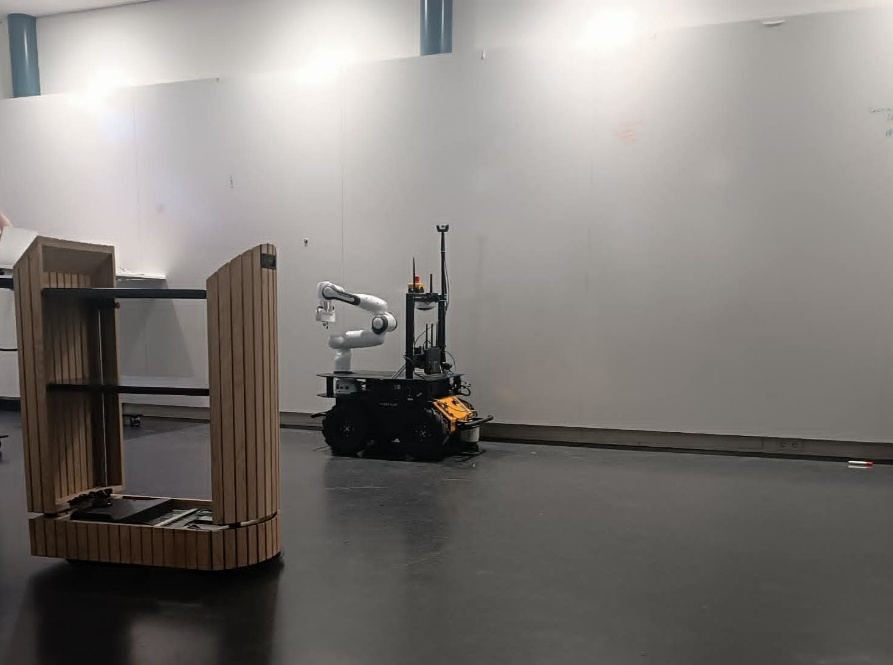
(Photo: Vasiliki Sivena – Rober left, Husky middle)
Rober (see also: https://dramaturgy4devices.sites.uu.nl/2024/12/21/rober-in-the-room/ and https://dramaturgy4devices.sites.uu.nl/2026/02/23/d4d-participates-in-art-and-technology-festival-highlight-delft/) is a hospitality service robot created by Dalco Robotics. To investigate how the performing arts can foster beneficial human-robot interaction (HRI), Lampe conducted two experiments with the device. In the first, he staged an interaction between Rober and two hotel employees with one acting as a customer and the other as a waiter, to evaluate the robot’s capabilities and explore how the participants’ embodied knowledge could inform Rober’s development. In the second experiment, Lampe placed participants in a room where they were asked to move through the space and navigate the robot’s presence. As Lampe monitored and occasionally controlled the robot using a pre-set system, participants tested Rober’s reactions by varying their movements; walking normally, slowing down, climbing onto furniture, or standing completely still.
Lastly, he demonstrated Rober’s navigation capabilities within the workshop venue itself. While the robot’s cameras and pre-programmed paths allowed it to sense the attendees’ presence, it could not provide feedback when blocked by a person. Consequently, it struggled to either prompt an individual to move or recalculate an alternative route. This limitation raised several critical questions regarding human-robot spatial dynamics: When exactly should a robot start responding to human presence, and should design focus on the machine’s “brain,” or on the architecture of the shared space itself? Furthermore, drawing from human behaviour where maintaining personal distance fosters comfort, the researchers questioned whether robots should be programmed with similar spatial boundaries.
Moving onto the third part, Tabone presented Husky robot, a project he is currently working on with Olger Siebinga. They are investigating how robots and humans can share the same environment without colliding into one another, especially in hospitals. This research draws inspiration from the “sidewalk salsa”, the phenomenon where two people repeatedly step in the same direction when trying to pass each other. The study utilizes a KUKA robot, whose design Rozendaal noted can appear intimidating due to its claw, especially when contrasted with the more approachable, hospitality-oriented design of Rober. This distinction highlights how a robot’s target environment must dictate its appearance, capabilities, and movement patterns. Expanding on this, Ulrike Quade drew from puppeteering expertise to argue that because robots do not move autonomously but follow assigned actions, highlighting their physical movements is imperative to making human-robot interactions readable and clear. Bleeker added that researchers should focus on understanding the core function and practical utility of these “actor-robots.”
To conclude the first session, attendees were invited to write their thoughts, questions, and insights in whiteboards, drawing from their respective areas of expertise:
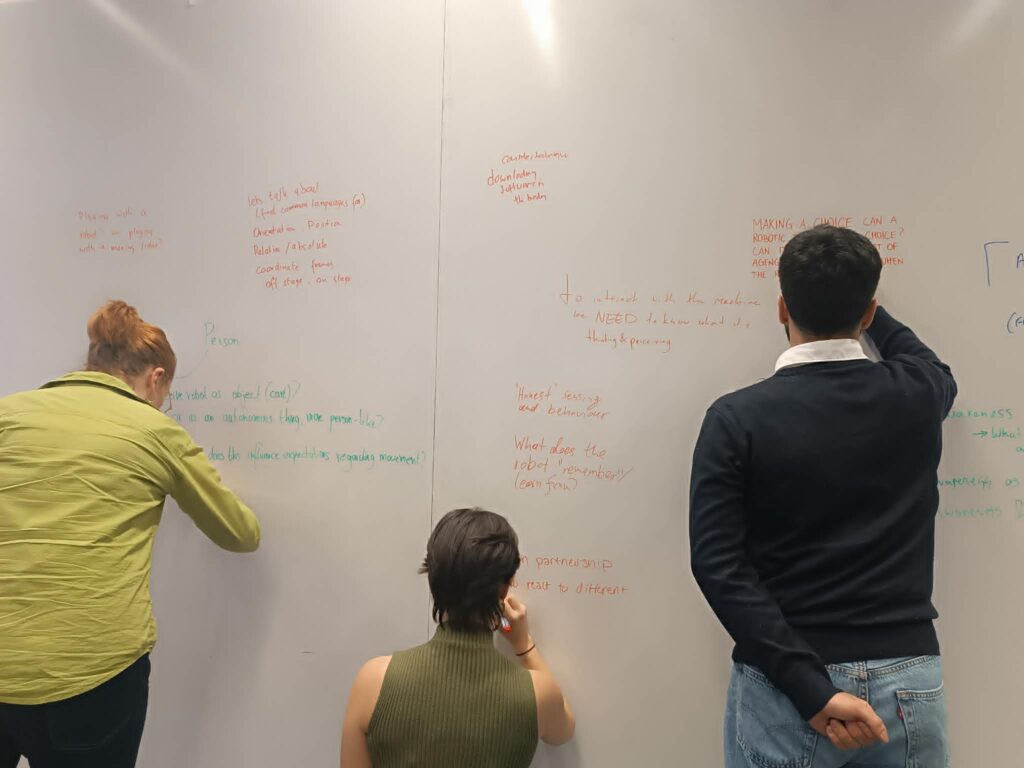
(Photo: Vasiliki Sivena)
The workshop concluded with a presentation by John McCormic who discussed his research combining robotics and performance studies. He introduced his recent project in Australia, “Moving with Robots”, which explores how robots and humans move and interact within shared work environments. As part of this work, he collaborates with dancers to better understand movement, coordination, and non-verbal communication. He also presented his research on his work “Future Noh” in Japan, which examines the practices of Noh performers and considers how their techniques and embodied knowledge can inform the design and behaviour of robotic systems. By studying non-western dance traditions through interdisciplinary frameworks and movement practices found in Noh theatre and Tribal/Transcultural Fusion Dance (TcFD), he aims to collect data that can be used in robotics. In this way, he aims to connect traditional movement practices with contemporary artistic and technological contexts, using robotics as a bridge between historical knowledge and contemporary artistic practice. This line of research explores the challenges associated with human–robot interaction in shared spaces. For example, in instances where physical interaction or improvisation between humans and robots is expected, important questions arise regarding a robot’s capacity to adapt and respond in real time. Can robots be equipped with sufficient contextual knowledge to improvise their movements? How can embodied human knowledge and movement practices contribute to the development of more responsive and adaptable robotic systems?