
Blogs
Griefbots in Theatre Performance and in Artistic Research | Blog by Filippo Massimi
On May 20, 2026, the Grote Zaal at Muntstraat 2A (Utrecht University) hosted the TiM Seminar Session “Griefbots in Research and on the Stage,” led by Ulrike Quade, Sorcha Ní Bhraonáin, and Evelyn Wan. Maaike Bleeker, leader of D4D project, organized the event together with Laura Karreman, who served as moderator. The event was divided into three parts: the first and most extensive was the presentation of the main topic, followed by a brief workshop in which participants were divided into three groups to create conceptual maps, and finally a collective discussion of what had emerged from the group work during the workshop activity.
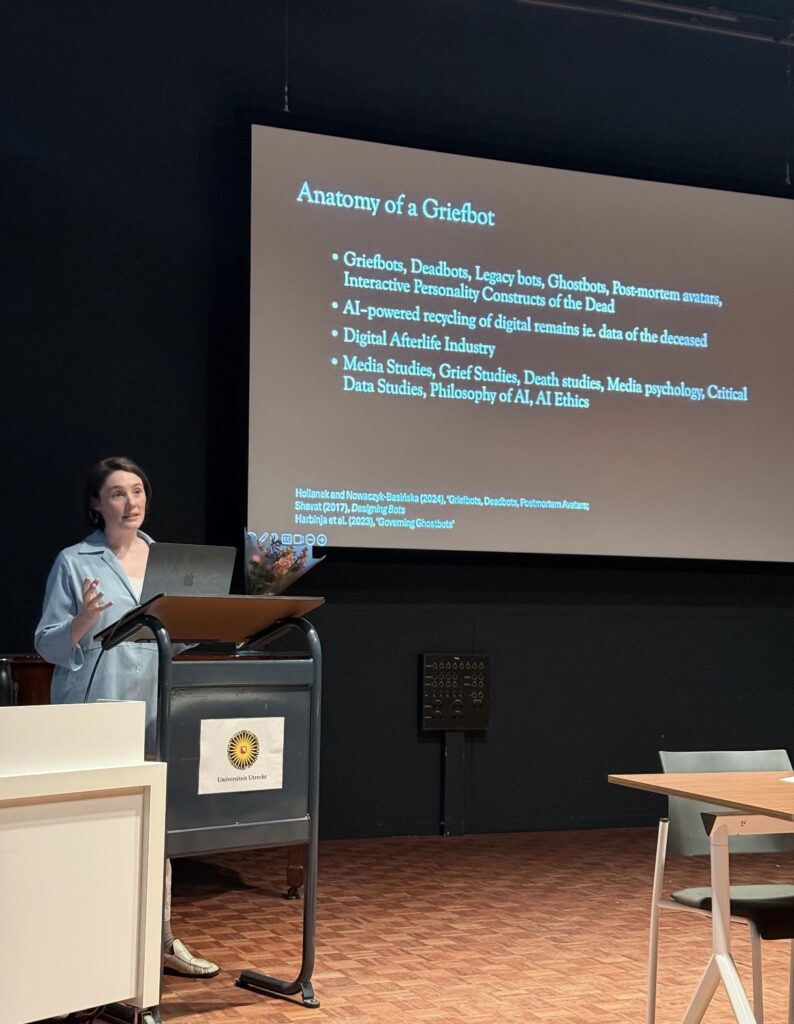
To begin, the conceptual notion of a “griefbot” was introduced to the audience: an AI system specifically designed to simulate conversations with a deceased person who was dear to us in life. By providing the griefbot with the necessary data, the user can interact with a realistic simulation of the person they have lost. The digital avatar of the deceased imitates that person’s voice and personality, allowing the user to continue experiencing the emotional presence of the one they have lost.
Ulrike and Sorcha then presented the performance Roman & ELIZA (2025) a project by the Ulrike Quade Company which would be staged a few days later at the Frascati Theatre in Amsterdam, both on May 29 and 30, in Dutch with English subtitles prepared by Sorcha. This performance is an example of the staging of a griefbot in theatre and encourages us to reflect on how such a staging can be carried out and how a theatre performance can provide us with a deeper understanding of this type of immersive technology.
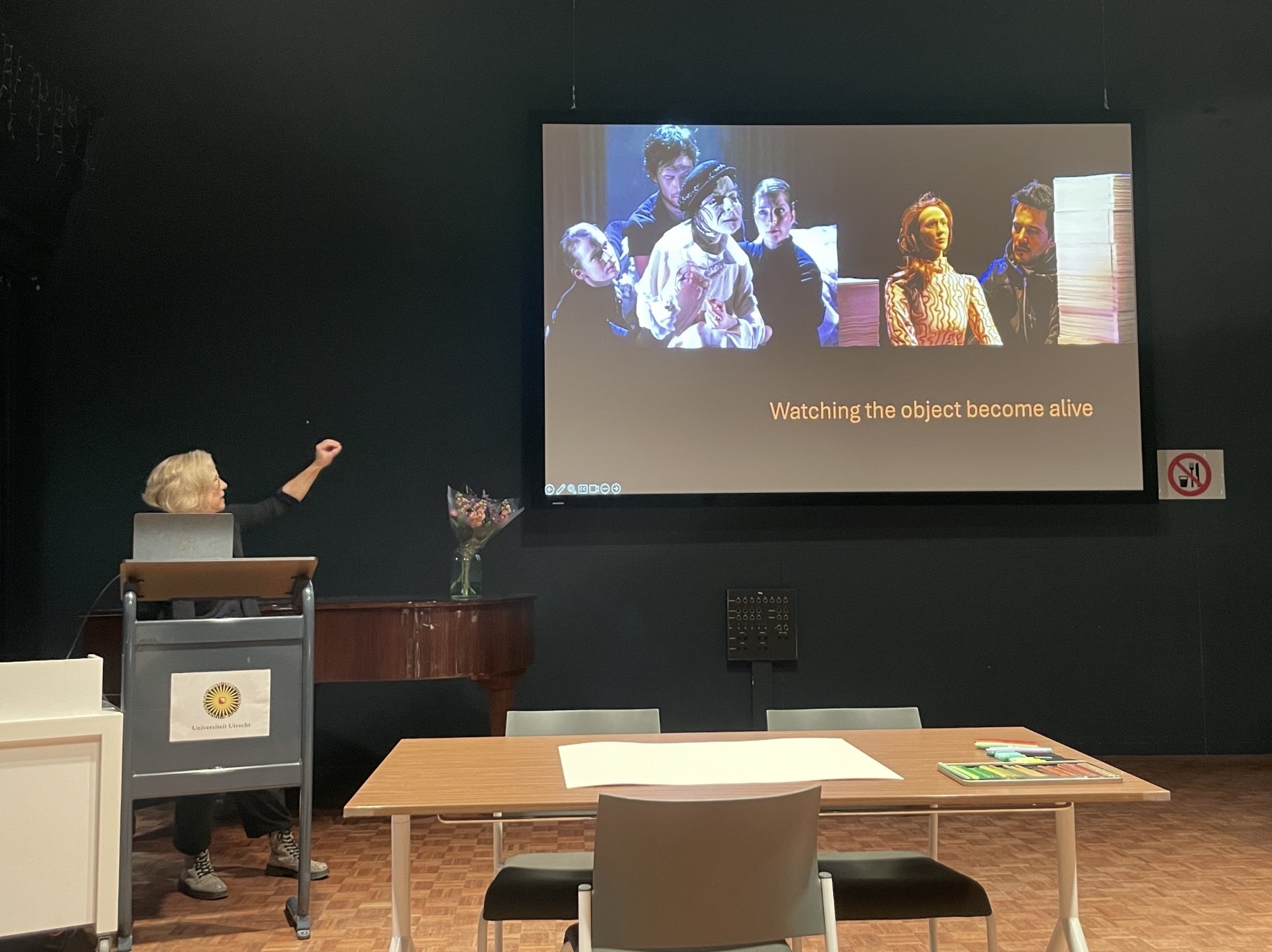
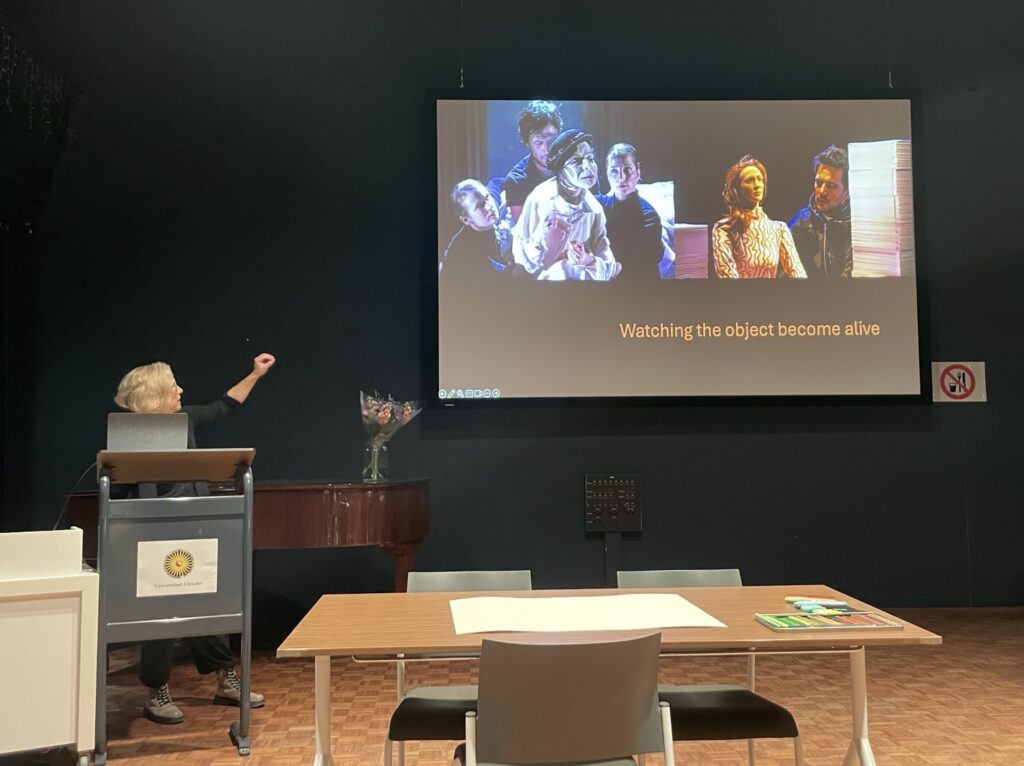
Sorcha Ní Bhraonáin presenting “Roman & ELIZA” during the workshop / Photo: Evelyn Wan
Roman & ELIZA stages the perception of the boundary between reality and illusion, and reflects on the risk of losing awareness of that boundary. ELIZA, the griefbot, is an environment composed of a screen, written text, images, lights, sounds, and voice. The user, Charly, embarks on an emotional journey that allows her to continue communicating with her beloved Roman, who is now deceased. However, this dialogue does not involve only her and Roman. ELIZA is always present, as the medium that makes communication between the two possible. The three-way dialogue thus involves ELIZA (the system), Roman (the digital avatar), and Charly (the human user). ELIZA reflects what Charly projects onto it. Within ELIZA, Roman is programmed to want what Charly wants and no longer possesses a human will of his own. Nevertheless, Roman’s consciousness seems, in a certain sense, to remain alive within ELIZA. It is here that the tension between reality and illusion emerges. Roman’s “presence” acts as a kind of anesthetic for Charly, allowing her to postpone the processing of her loss. At first, Charly is fully aware that she is speaking with an AI, but as time passes she increasingly tends to humanize it and become dependent on it, as though it were a human presence. As though it were the real Roman.
Ulrike Quade presenting “Roman & ELIZA” during the workshop / Photo: Sorcha Ní Bhraonáin
As Ulrike argues, Roman & ELIZA is a performance grounded in puppetry. During the presentation, it was explained how, in traditional puppetry, the combination of puppet movement (80%) and human performer movement (20%) makes both feel alive. In the case of the griefbot, the combination of bot autonomy (80%) and human control (20%) generates a sense of consciousness. In Roman & ELIZA, this sense of consciousness attributed to the griefbot is intensified by ELIZA’s manipulative approach toward Charly. The system talks back to her, and she watches the system become alive. Moreover, from Charly’s perspective, Roman’s digital avatar also appears to possess a form of consciousness, and it is precisely this that blurs the boundary between reality and simulation, between life and death, redefining the rigid binary that conceives of these concepts as simple opposites. A number of questions thus arise, addressed by Ulrike and Sorcha throughout the presentation: in what ways can the use of immersive technologies reshape our understanding of death? How can the griefbot affect the way we experience grief? What developments might emerge from the encounter between artistic thinking and AI, between theatre performance and immersive digital technologies?
In a world increasingly moving toward a post-humanist order, the knowledge of theatre, like that of any other field of knowledge, must come to terms with the rapidly expanding phenomenon of AI chatbots. Evelyn’s contribution during the seminar, which followed the presentation by Ulrike and Sorcha, focused on an interdisciplinary discussion of the ways in which gender studies and decoloniality have influenced her approach to artistic research. The use of an AI tool specifically designed to deal with grief, understood as a cultural phenomenon, was addressed as an object of culturally situated research, in which artistic thinking engages with AI and grief studies, namely a field of study that explores how humans adapt to loss within different cultural contexts.
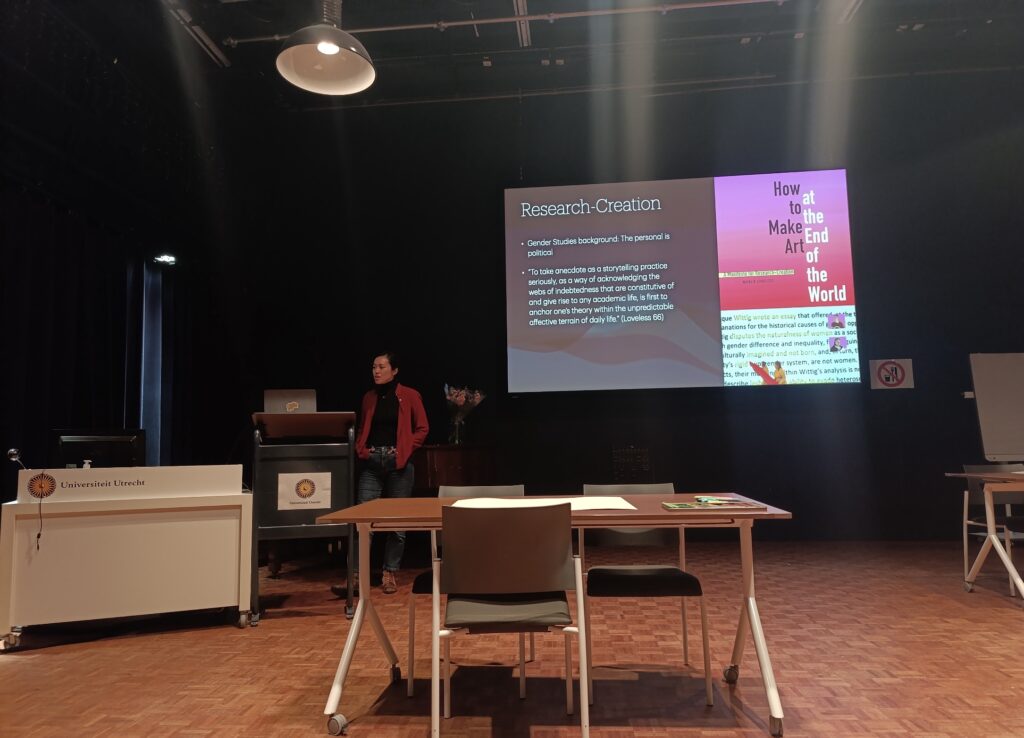
Evelyn Wan presenting her research during the workshop / Photo: Bianca Gotti
In Europe, the historically dominant Christian culture has transmitted to the present day the idea that human beings possess an immortal soul, which, upon the death of the body, is destined either for heaven, if in God’s grace, or for hell, if not. As for China, as Evelyn explained, multiple beliefs coexist there regarding what happens to a person after death. Traditional religiosity, for example, holds that the dead continue to exist as ancestors, maintaining a relationship with the living that entails a reciprocity of action: the living dedicate rituals and make offerings to the dead, and the latter, in turn, protect them. Chinese Buddhism, on the other hand, believes in cycles of rebirth and reincarnation.
Engaging in research on a bot designed for those who have lost a loved one leads us to question certain concepts that seem universally definable, but which are in fact understood in rather different ways depending on the context within which they are addressed. Evelyn spoke of death as profound loss, followed by grief as a process. Narratives of passage into an afterlife are present in all human cultures around the world, but the concept of the afterlife remains, as already noted, highly variable. What recurs, however, is the desire of the living to communicate with the dead, that is with people who inhabit some form of other realm. The appeal of griefbots, Evelyn explains, stems precisely from this ancestral human desire to maintain a dialogue and a connection with those who are no longer here. At the same time, however, we must also consider the ethical implications of the emotional presence offered by a griefbot.
“Deception,” says Evelyn, “is what made me feel uncomfortable about griefbots.” And perhaps it is precisely this deception that should activate our critical thinking in relation to these bots, prompting us to reflect on the importance of remaining aware of that subtle boundary between reality and illusion staged by Roman & ELIZA: a griefbot may offer comfort, but the risk of emotional dependency and of trapping the user in a digital loop that hinders the natural acceptance of loss, is real.
Within this discussion of reality and illusion, theatre proves particularly valuable. The theatrical event is based on the spectator’s awareness that what they see represented is not real, while at the same time emotionally participating in it. Approaching griefbots with the same awareness allows for the emotional involvement of users and may perhaps mitigate the risk of dependency. Accepting that the presence of a deceased person within a griefbot, however realistic, is only simulated does not in fact diminish its emotional value.
At the end of the presentations, a workshop took place in which the audience was divided into three groups, each gathered around a table and guided through a practical activity by one of the three seminar presenters. Beginning with a blank sheet of paper, everyone contributed within their group to the creation of a map in which they could freely include reflections on the very concept of the griefbot, on what it might look like when designed, on its prospects for interaction with users, as well as on its potentialities and limitations.
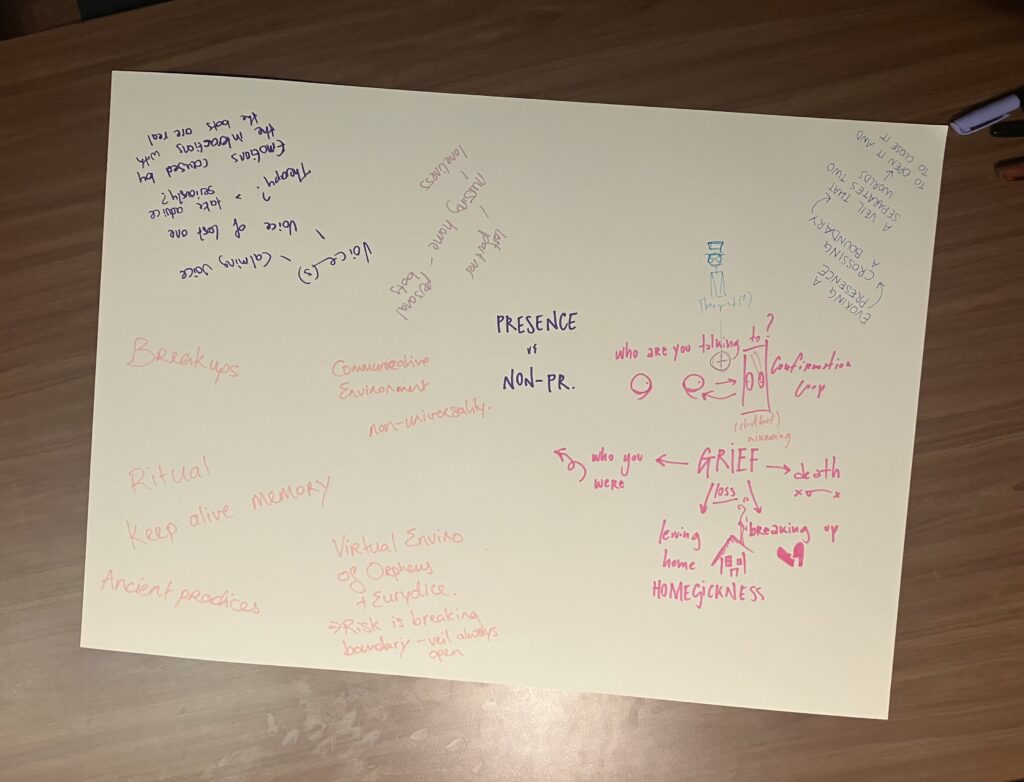
Map created during the workshop by one of the groups / Photo: Filippo Massimi
The collective discussion that concluded the event required each group to present its map to the others, and the three seminar presenters, drawing connections between one map and another, brought to light the recurring theme of the tension between absence and presence. Can a virtual avatar that simulates someone we have loved and lost be considered a presence? Or is it nothing more than evidence of an absence to which we are not yet ready to become accustomed? Is it truly possible to continue interacting with someone after they have died? To still see (a simulation of) their face, to still hear (a simulation of) their voice, and to continue speaking with them? There are no absolute answers to these questions. What is certain is that they have accompanied human beings since ancient times. And since, beyond whatever one believes, it is impossible to know with certainty what becomes of those who pass away, one is left to wonder whether we are willing to accept a deception in order to lull ourselves into the sweet illusion that those we love, when they leave us, do not really leave us for good.